
Dear Everyone
June 2, 2025
Dear Everyone,
O plans to be a doctor, and I have no doubt he will be a great one. He is a kind, bright young man with a curious mind and full heart. He questions himself, gets lost in his sadness, is moved by beautiful things and loves deeply. He sometimes feels more alone and misunderstood than he is. His friends, and so his family, are endless.
I first met O when he was a student in my nonfiction writing class, the kind of class that became an experience cousin to family. Visiting the classroom each week, though as challenging as any class I have taught, felt like walking across the threshold of home. The students wrote incredible things, had inspiring, complicated debates about religion and philosophy, masculinity and Italian cooking. I watched O soak it in. Many class periods he talked almost as much as I did (if you can believe it). He was also, if I remember correctly, usually five minutes late.
A year later in another class of mine, O handed me a book—Dear America: Notes of an Undocumented Citizen, by Jose Antonio Vargas. “This is my story,” O said. He asked if I would read it. The book sat untouched next to my bed for weeks. Once I started reading, I finished in days, and then talked about it to anyone who would listen, and I told them (without specifics) about O.
Until I read Vargas’s book, I had no idea O was living as a college student in America undocumented. “This is my story,” O had said. I didn’t know why he hadn’t told me sooner. We had talked for countless hours in my office and while hovering in fluorescent-lit hallways. I deeply cared and care about him, as I end up caring about so many of my students. But how do you tell someone something that shouldn’t be a thing you should have to worry about? Add on the shame of having to explain a thing to people that never worry about that same thing. O is hardly alone, people through language or law made to feel like strangers, or disappeared, deported, and exiled by others with more power in nations like this one.
Dear students. This is our final assignment for our recent America Literature class—letters to our class about our class, as it all evaporates into memory. I’ve named this final assignment “Dear Everyone,” as all semester you wrote letters, like Vargas, to poets and politicians, to yourselves and to your family, letters which beyond occasional sharing in class I fear I have been the only recipient. These final letters, this one included, will be gathered and sent like gifts to each one of you.
After reading Dear America, I imagined our class, much like how we imagine nations. I didn’t see you, and I didn’t yet know many of you. So I had to imagine you, which isn’t anything not real.
The first day of class we sat in a windowless Pennsylvania room with eggshell-white walls and we listed on the whiteboard who we were and from where, hometowns from Delaware to Mexico, ancestry from the Caribbean to Asia. I asked you what American literature was, where it might be found and recognized, and what it was for—and it was that last part I told you our class would study, the why of any learning.
Imagine a classroom. Imagine a chemistry class where students only watch chemical reactions on television. They do not add catalyst to solution. They don’t mix chemicals into beakers and watch them spin. Nothing explodes in the name of science. Imagine a math classroom absent of students solving equations. Students instead sit in rows watching someone perform solutions in front of them, followed by quizzes, exams, etc. Such imaginations feel patently absurd. In science class, students experiment. In math class, students work step-by-step to solution. Imagine a literature class. Imagine students reading literature, listening to a professor talk about words and books. No one twists metaphors into understanding. No one mixes genres and then gauges audience response. Nothing explodes in the name of experience. Students sit in rows explaining a poem or movie or novel, or being explained to, followed by properly cited research essays, exams, etc.
I am hardly alone finding great pleasure and meaning in words, while finding the literature classroom typically boring and unreasonable, much as I admired and loved my professors. It wasn’t until I found the creative writing classroom that literature came alive for me, as I saw it made by failed humans like myself, something I had somehow missed until then. I’ve told you my theory of letters as our clearest form of literature and literary experience. How seeing a poem or novel or play as a letter can help us see the thing more clearly, remove it from whatever is keeping us from seeing it as our own, as us, as something as human as a bowl of rice. One person talking to someone else, both you and someone else at once, like an entangled quantum particle. You and not you. Both always. Demanding textual stability in this entangled space both obscures the reality of literature and empties it of meaning. This letter is written for you and not you. Hamlet is mine and not mine. “A Letter to My Nephew” is written to me and to James Baldwin’s young namesake, another James, and to you. This is my story.
I only discovered the other week while reading D. G. Myers’s insightful book about the history of creative writing education, The Elephants Teach, how the creative writing classroom was developed in the 19th century as a response to studying literature in a formal, scientific way, as inert thing, misconstruing how words and expressions function for individuals and community, poems not things we come to understand behind glass or on anthologized pages, but active energy in our loving and our fear, helping us create sense of self and other, working through us like blood and air.
Dear America is a book about who belongs in, to, and from America—this imaginary, real, often violent force over a place we live. And, if not Vargas—a high achieving student, Pulitzer-winning journalist, loving and loved member of a broader national community—then who belongs to and from this place? When Vargas was 12 years old, his mother sent him from the Philippines of his birth to live with her parents in the United States. It was not until years later, when he was applying for a driver’s permit, that Vargas discovered he had emigrated to America without proper documentation—“illegal,” as news agencies and gossip slander and slur. Though it is criminalized to enter this country without following established code, there is nothing illegal about being here. The Constitution protects people, not citizens (though the current administration might pretend this not the case). It’s a language battle of who is us, who gets a story or part of a shared one. Metaphors, linguist George Lakoff argues, fabricate the real. Illegal. Undocumented. You and us. Why did Vargas write his book as a letter addressed to America? Identity doesn’t exist alone, Vargas understands, citizenship or otherwise, but only in conversation with the other. Dear America then is importantly a story offered as a letter to us, them, you. “This is my story,” he said.
After leaving the Philippines as a boy, Vargas did not see his mother again for 31 years—not until three months ago. Who imagines a world so cruel, where the simplicity of a mother’s touch might be too much to ask?
Letters to and from America. That was our class. We read Vargas and Plath, Coates and Dickinson, read letters as poems and poems as letters. We broke down the letter form—addressed, addressee, medium, message—and applied it to plays and memoirs and to our own writing.
We learned from Terry Eagleton how literature is never stable but always shifting around morals and values of groups and individuals, perhaps most easily noticed by what gets taught and what gets left out, what books are added to and removed from library shelves. We studied Benedict Anderson’s theory of nations, how because of size and scale they always exist on the plane of myth, the imagined, not unlike things we read about in novels, which Anderson argues provided readers shared scripts for citizenship. Nations were born in the pages of books and continue to be shaped there, and on screen and in song. “Imagined community” is how Anderson distills the national experience, and, like so much, not less real because imagined.
“Nations are not communities and never have been,” counters Howard Zinn in his multi-vocal history of America, a book stitched together from overlapping, interwoven voices in the pursuit of community, acceptance, and justice, alongside other voices in the pursuit of division, violence, and power. From diary entries to pop culture and ancient texts, we are only ever addressing others when we use language, friends and strangers, future selves and distant audience. Identity, national or otherwise, is other-referenced—even “I is another,” to quote Rimbaud—and so our literary tradition is only always one of direct address, which manifests in national literature as an always fluid argument for or against inclusive community. Who are you addressing? “This is my story.”
A little over a month ago, I told O how I had built our class inspired by him. “Really?” he said, both inflected with surprise and flat at once. I don’t know how I would respond either. I can barely accommodate the slightest compliment to myself. It meant much to him, though, I could tell. Like many of you, O has graduated college since I last saw him. I get to know you, some deeply, for only a moment in your lives, a time I hope to have been some use. It is truly an honor.
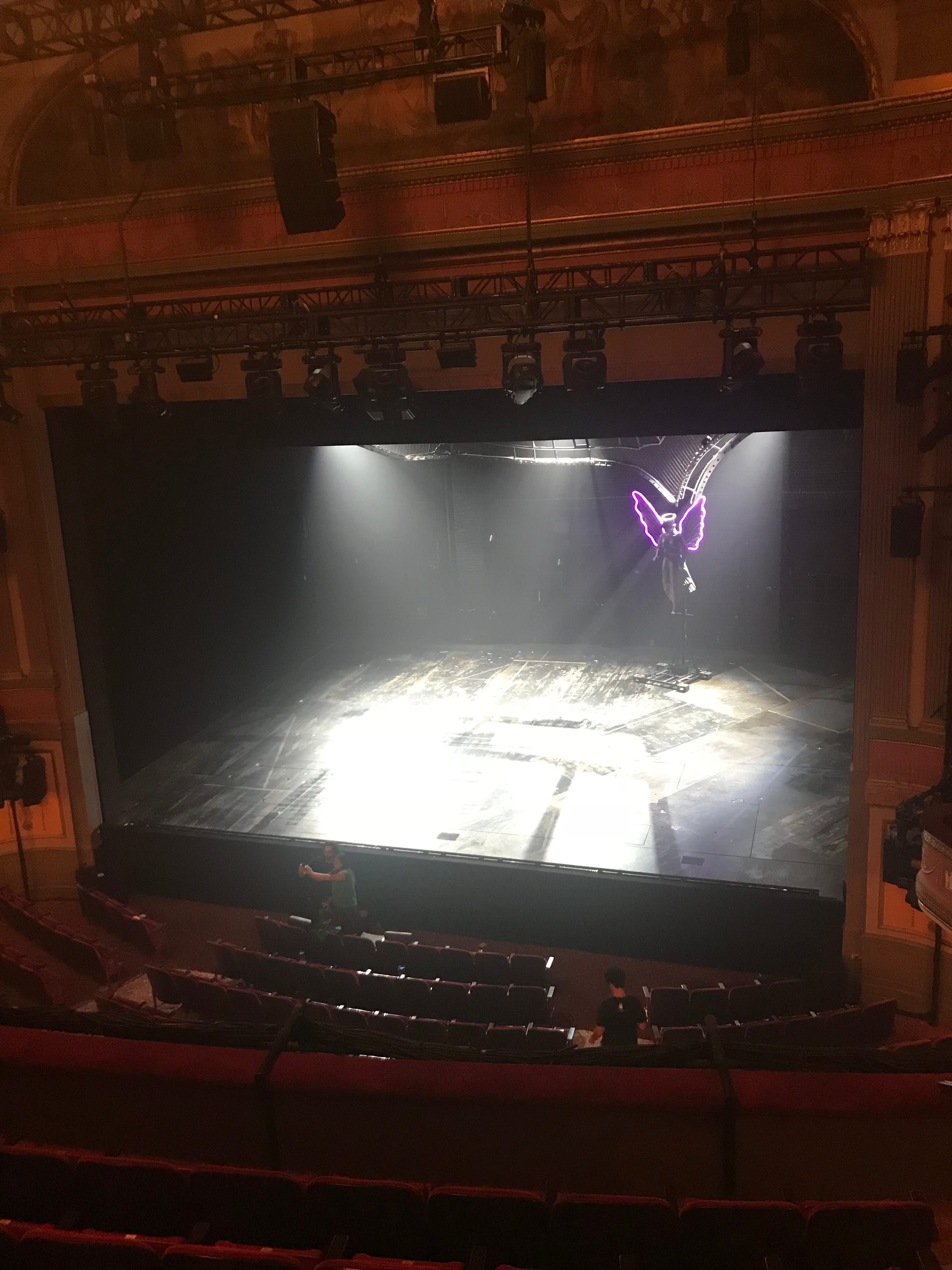
I’ll end with a section from Tony Kushner’s play we read in class, Angels in America, a work everyone seemed to find powerful, as I did when I first read the play in high school and still do. The play was initially funded by the same National Endowment for the Arts now under so much attack in an effort to undermine literature as a shaping voice in our shared imagined community. Our voice. These lines towards the end of the play you kept repeating in discussions and in your letters, found important for yourself and whatever community and conversation we shared then and, I hope, continue to share, and so I return them to you here:
We won't die secret deaths anymore. The world only spins forward. We will be citizens. The time has come. Bye now. You are fabulous creatures, each and every one. And I bless you: More Life.
Always,
Travis