Fragile Dragons
August 8, 2025
“The American idea of masculinity: There are few things under heaven more difficult to understand or, when I was younger, to forgive.”
— James Baldwin,“Freaks and the American Ideal of Manhood,” later retitled “Here Be Dragons”
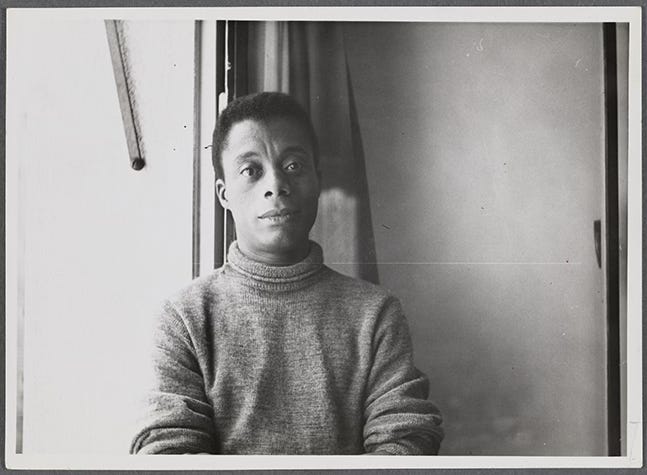
Saint James,
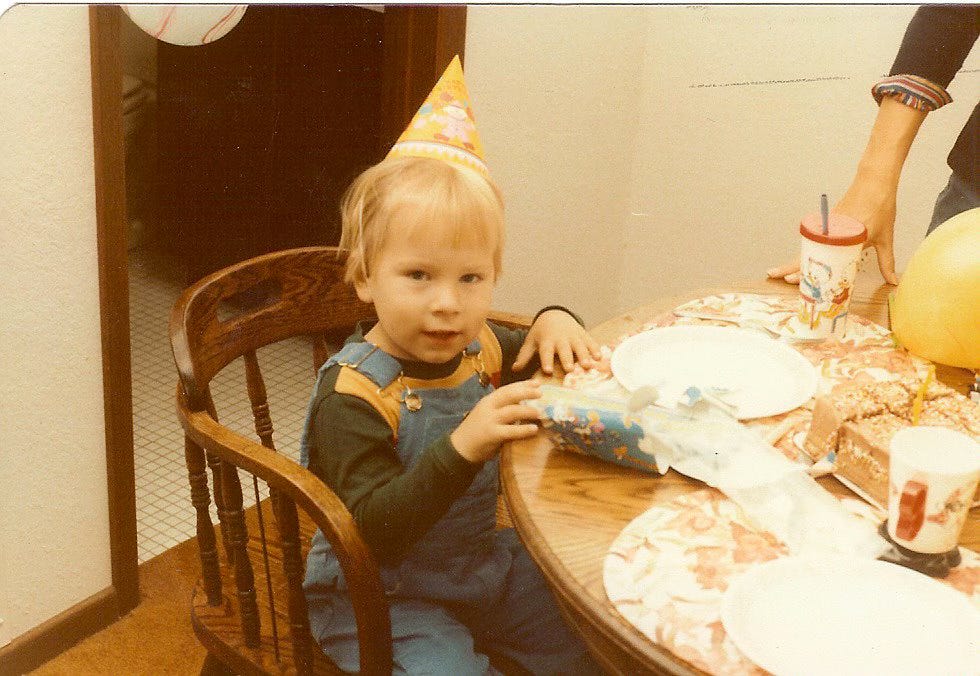
Birthdays in childhood were experienced as glory, also as tests of allegiance and identity, the days and weeks before a birthday tense with expected joy alongside anxiety for potential rejection and ruin, the party invite list negotiated with benevolence, idealism, and inclusion, delicately managed to mitigate disappointment. I would worry friends wouldn’t come, invite boys hoping that they would, their acceptance of invitation a signal we were copacetic, on the same side, that I was respected, seen as worthy of whatever boys need in that regard, their needs and my own.
I cannot easily or particularly recall individual distant birthdays, mine or others, only the events altogether as a flavor of experienced feeling, though some uniquely marked by anomaly. A 30th birthday celebrated with a single piece of store bought sheet cake scalloped in plastic. A daughter’s birthday taking in the musical Fun Home just weeks into its Broadway opening. How some experiences fashion moments into images, repeated as the self remembering, though every forgotten, unfashioned thing also shapes and has shaped the self, and you either drag the past with you or it drags you, as you once memorably said or wrote, both now, since you’ve gone, experienced the same. Without a body the self petrifies into recording.
October 1988. The only reason I remember seeing Beetlejuice at the movie theater for my 10th birthday is what happened after, with boys invited in that fragile, fuzzy border between friendship and chance, boys I happened to have gone to school with, shared bus rides and classroom desks with, who after the movie, as we explored the backyard forest distant from adult presence, ran in dizzying curves between the trees chanting “Round Boy, Round Boy…,” chanting the words at me and so about me. They were repeating a line from the movie we had just seen, life quickly and decidedly mimicking art. Michael Keaton, the star, playing an undead ghost, aimed the epithet at a chubby snob in a moment pitched to viewers as comedy, a kind of entertainment perhaps always for the purgation of our common cruelty. Laugh at the fat man. Laugh at the man who loves art and fashion. The queer. The elitist. And between the trees those feelings of cinematic power, righteousness, and weakness were transferred to my body as easily as picking up and tossing a small stone. I no longer remember if I was chasing them or them me as they sang, whether I was running through the trees out of desperation or exile, but I do not think it makes any difference.
When you were a boy your stepfather called you ugly. Later, and not much later at that, other men would find you beautiful and want to fuck you. Women, too. And then other boys and men would hound you, insult you, attack you in the same Harlem streets they would also ask to touch you, gently and generously, and ask you to touch them. Ursula K. LeGuin—a writer I am sure you were familiar if not friends with—once described maleness as “so difficult and so fragile that the boy has to keep forever asserting that he's a boy.” A diagnosis that begins to make sense of the male gender performance our current executive branch desperately tries to cover up, by which I mean to standardize and stabilize, a government currently teeming with those kinds of anxious boys who on the streets of Harlem chased and attacked you, insulted you and beat you, boys certain of their fragility and so forever asserting and asserting they are boys, and the only way they seem to know how to do this is by erasing anything and anyone who, they believe, makes them feel otherwise. I’m a boy, I’m a boy, I’m a boy.
One of my students presented research recently at a local academic conference about one particular person in the executive's circle who with righteousness and glee gave a speech about America’s need for “daddy” to return home and spank his daughter. Alpha and beta, authority and submitter, male and female, spanking and spanked. I’ve spanked, consensually and in shared pleasure, many times during sex. I have never been spanked myself except in punishment, and even then perhaps only once or as part of some sort of collective unconscious, not spanked myself but within the sociology of the spanked, and if the latter, why do I not have a collective unconscious of being spanked, not as punishment or erasure, but in joy?
The first writing of yours I read was your short story “Sonny’s Blues,” assigned for some class I took, a story about one brother out of jail thinking about the other brother, an addict and inspired musician, in jail, story about one man thinking about his identity against another, two sides of the same identity coin. These kinds of characters are called foils, the understanding of one character arrived at through the reflection of some other character. Dr. Frankenstein and his creature. The assorted daughters of Little Women. A western literature rife with paired sons: Hamlet and Laertes, Achilles and Hector, Harry and Draco. This is how the couple David and Giovanni are experienced in your 1956 novel Giovanni’s Room, two sides of a coin. Lovers, in other words. My daughters have taught me to “ship” characters in television shows and movies, enemies and friends audiences-turned romantic. It’s an act of minor rebellion originating in joy against the pressures of rigid identity, sexual and otherwise. We break out of our prisons by freeing characters from their plots.
Late in your life—you died from stomach cancer in December 1987 at your home in St. Paul de Vence, France, hours before your final novel, Harlem Quartet, won the French-American Friendship Prize—you published an essay titled “Freaks and the American Ideal of Manhood” in Playboy in 1985. You later retitled the essay “Here Be Dragons” and included it as the final essay in your last book, The Price of the Ticket. “Freaks and the American Ideal of Manhood” is the kind of essay I didn’t know you had written until I stumbled upon it a few years ago. “Freaks” is an essay both lodged in its time and written for a future, maybe not yet this one, or very much this one. We watch anti-trans rhetoric and legislation soak the nation in a guilty patina. We fear what we desire or don’t understand, usually both at the same time. “Freaks” is a courageous look at what it means to be sex and be gendered, always being something in between and and, or both, in the inarticulation of binaries. “Freaks” is an essay about how we are all both sexes, both genders, a bit of all the categories everywhere. You didn’t find categories, such as race and gender and nationality, all too helpful in your life and your work as activist and artist building a better here for everyone. You thought only complexity would ever save us, save you.
I’ve always found myself pretty when I want to find myself tough. This is me looking in the mirror. Me admiring my soft face then reviling it. This is me looking at a reflection I walk past and seeing a model’s lithe gait and frame and me looking at photos or videos of myself and seeing only weakness and lack. I’ve always been interested in sex, fashion, bodies, which is maybe why I’ve tried to not focus my life around these things. Like alcohol, drugs, all kinds of deep presence or deep escape, I know my ecstasy can be so deep I will never leave or never return. Maybe this is why I am writing to you.
My students ask, as I am sure your students asked, why I chose writing, how I got there or here or somewhere, tall and unshaven standing before them earning half the salary of their parents and my friends. This half-poet. I tell them I tried acting and found myself not trying enough. You started preaching as a young teenager and were good, or so the biographies say, but you needed to find yourself pretty and love how that felt and not be filled with shame or have others take their shame out on you. No one called me ugly to my face. I married, unmarried. You threw your wedding rings into the Hudson, loved Lucien, loved many. You died 8 years after I was born.
We never met, boy from Oregon, man from Harlem, in the small years we overlapped. I hope you would have found me cute, charming, perhaps too talkative. VHS home movies my father recorded in the 1980s and early 90s show me as non-stop Greek chorus, perhaps only a bit more high-pitched and less assertive than my daughters and students and others experience now. Maybe you would have seen some of yourself in the pale boy in thick, Coke-bottle glasses desperate to know and be understood and feel and wondering why those around him didn’t seem as desperate. Would you have found me pretty, later as a man. In the boy, would you have seen yourself and your own strong desperation. Could you tell that I was always already leaving, trying to find space, the privacy of other places to afford some kind of knowledge.
One great pleasure of reading your books is they are filled with characters as foils, mirrors, selved others. Giovanni’s Room is a book told by a man, David, looking into reflections and memory while mourning his abandoned beloved, Giovanni, considering how much his beloved mirrored him, reflected and unearthed him. Giovanni isn’t dead yet in the book, though he is to be executed soon. David is mourning how emptied he has been by the denial of his reflection, his lover, his other, and so himself. We don’t just see others, we become them, and they us. “Freaks” is about this as the human condition, and how the denial of this—your worry was about masculinity in America—is a kind of sickness. Rene Girard described this as mimetic desire, that the other is the one who we find ourselves desperately within.
I already knew Michael Keaton from the movies Mr. Mom (1983) and Gung-Ho (1986), the latter I remember watching with my dad, though I don’t remember much about it except that Bill Murray played a character who worked in a Japanese automobile factory, and cultural differences between him and Japanese employees led to obstacles and an eventual reckoning and deeper understanding had by all. I think there was an ice plunge scene, the shirtless men bonding in the deep cold water.
My father spent much of his waking hours building and fixing things. He spent the majority of his working years teaching high schoolers how to disassemble and repair cars and computers. It is him I remember teaching my brother and I to vacuum in careful, overlapping lines, and him I remember as much if not more than our mother at 5:30PM stirring vegetables, beef, and rice stir-fry in the wok. When not doing what seemed endless chores of cleaning or mowing or digging, I spent time reading comic books and playing Dungeon and Dragons, or thinking about those things, or thinking about girls. Long after my mother and my brother and I had fallen asleep, my father would lay in bed reading novels. Our tiny home library was a small shelf in the office room filled primarily with novels he had read — Isaac Asimov, Stephen R. Donaldson, Tom Clancy — some my brother and I would later pick up and read ourselves in bed or in the tree filled acreage between our house and the mountain river behind.
I can’t remember now if it was the strange and humorous movie trailer, Michael Keaton’s star power, or Winona Ryder’s young beauty that drove me to want to see Beetlejuice on my birthday. Over the following years I watched the movie a dozen times, developed a not uncommon crush on Ryder, and followed Keaton’s career from Batman to Birdman. I don’t actually remember going to the movie that birthday. At the same time I’ve never forgotten the afternoon following the movie, running in the woods towards or from the other boys.
Elif Batuman talked recently about how we diminish our desires compared to our productivity, things felt more important, more real. Specifically, she was writing about childhood unhappiness:
What if we lift it out of the realm of the personal, and make it into something as important as the Iowa Caucus? What if we give it the same level of importance we give some very rote part of governance on every news channel? What if we take childhood unhappiness seriously? What if we don’t say, ‘Oh it’s unavoidable, it’s normal for kids to be lonely, it’s normal for kids to be humiliated in school.’ What if we take it seriously? The loneliness, the crushing, and the instilling of a need to crush.
You were already dead a year that afternoon we went to Beetlejiuce. A year before or after this movie, one of those boys and I had sex, not for love but discovery, as children often do. But then who am I to say what was and wasn’t love for someone who lived near forty years ago bearing my name. As a child, one doesn’t feel childlike, which is an object, a reification, not a state of being. One feels like a plant, like a book, like information and emotion moving towards sunlight, bottles of soda, and sleep. I saw the boy again a decade later, both of us young men at university. One of us saw the other in the cafeteria and said hello. We sat and ate together. That was the last time I saw him.
You are dead and we never knew one another. I write these letters—I write you—because you wanted to write your way out of these stale stories. So do I. You can’t feel love if it’s ruined by guilt and worry. Nor, maybe, can you give it. In “Freaks” you wrote:
We all exist, after all, and crucially, in the eye of the beholder. We all react to and, to whatever extent, become what that eye sees. This judgment begins in the eyes of one's parents (the crucial, the definitive, the all-but-everlasting judgment), and so we move, in the vast and claustrophobic gallery of Others, on up or down the line, to the eye of one's enemy or one's friend or one's lover.
Foils, David and Giovanni, the president and me, prisoners and their guards, the dying in Gaza and those watching. You continued:
It is virtually impossible to trust one's human value without the collaboration or corroboration of that eye -- which is to say that no one can live without it. One can, of course, instruct that eye as to what to see, but this effort, which is nothing less than ruthless intimidation, is wounding and exhausting: While it can keep humiliation at bay, it confirms the fact that humiliation is the central danger of one's life. And since one cannot risk love without risking humiliation, love becomes impossible.
I did not see Beetlejuice for my 10th birthday. The movie was released March of 1988, and my birthday was many months later in October. I misremembered. We saw the movie, still circled one another beneath the trees, but it was in the spring, and it had less to do with me than I long believed. I can still see them now, the boys, their bright eyes, can hear their voices. Can see and hear us. After our parents, other children are the stage of our becoming. That 10th birthday, I actually went with different boys to see the Diane Fossey biopic starring Sigourney Weaver, Gorillas in the Mist. More delicate boys, but only in our minds. After the movie we became paladins, elves, disappeared together.
I have been attending a group here in the city trying to diminish violence and suffering among young people, a group working in our community to connect young men and women with resources and love, tough and tender. A few meetings back, one woman told us about the work she was doing in the local prison, doing writing work with some men there, writing letters. She told us about how one guy got deeply invested in the activity, first while he was writing a letter to his future self—she described how he was sweating while writing it—and then when he wrote a letter to his past self he even unbuttoned his jumpsuit he was sweating so much, blew on his chest. He said, “Man, this is rough!” She told us it was obvious how important it was to him, the writing, how much he needed it. He told her, “I’ve never done anything like this before. It feels like I’m talking to myself.”
Mon semblable. mon frère,
Travis