If I Told You I Feel Like I Know You
April 23, 2025
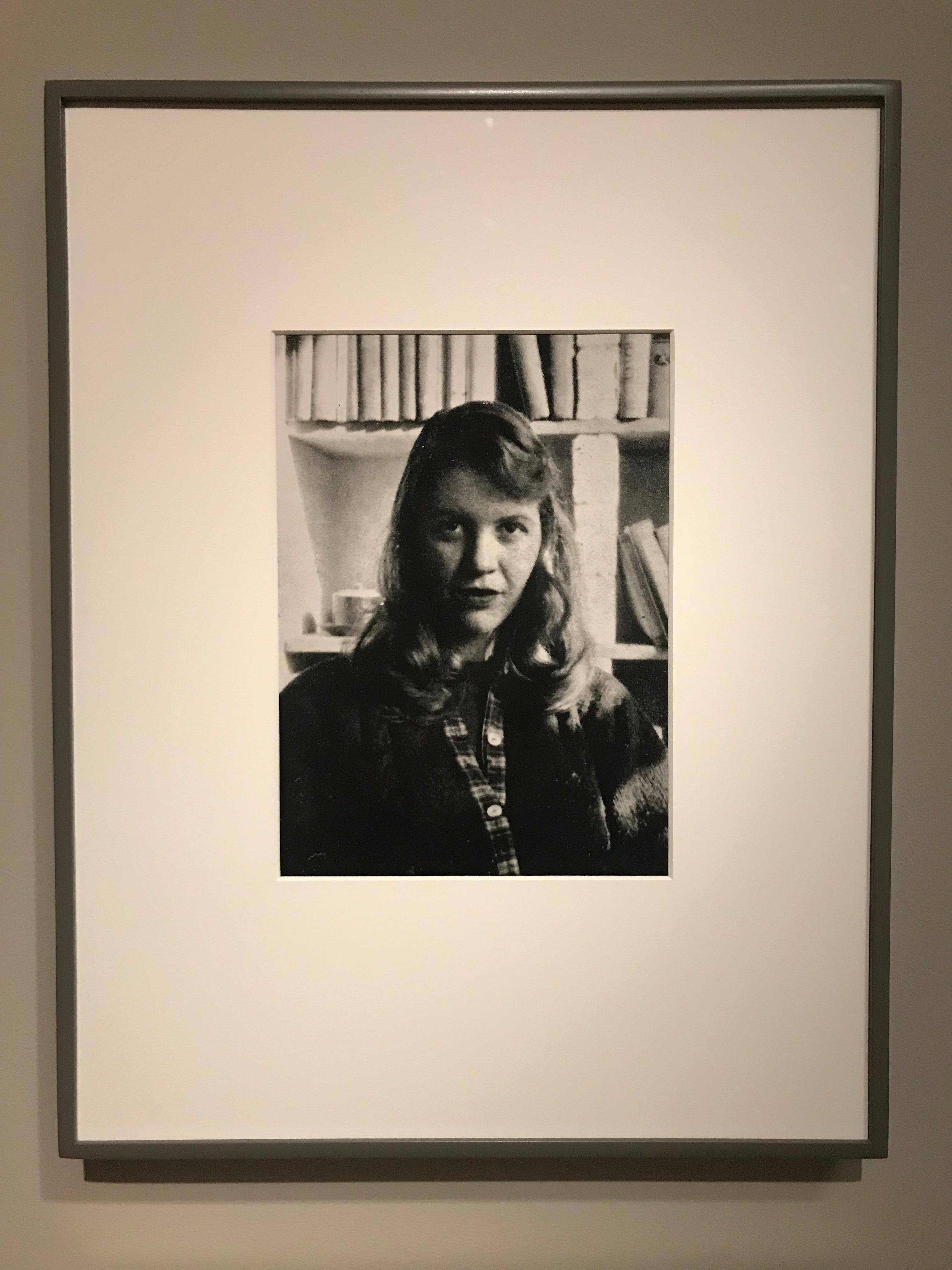
Dear Sylvia,
I am flying over Kansas on the way to Los Angeles for a writing conference. I was just an hour ago reading Frances McCullough in her introduction to The Bell Jar posit that because you died so young at age 30 it’s easy to accidentally experience you as a contemporary. Yesterday I played audio of you for my students, some BBC recording or such, where you talked about why you preferred living in England over America, why you left the latter and remained in the former, rationalizing, I feel, as we do, our circumstances, and you said you thought children in America were a bit too set loose, too unrestrained, and you wanted a more strict Victorian experience of childhood for your and Ted’s children, which, I’ll admit, was not the position of the progressive feminist I experience you as in my head. We’re imprisoned by our lifetimes, though we are experienced within the lives of others. You died by your own hand fifteen years before I took my first breath.
A writing conference. It’s one of the things I do to try to be of use, to have more than a ghostly imprint on the world, the negative presence Esther Greenwood feels herself to have when her friend gets all the attention at the New York City bar in the first chapter of The Bell Jar. The same feeling you had, why you drove yourself, felt you had to every day once again prove yourself to be a writer. I don’t like imagining you going to this writing conference or any, because like Elliott Smith or Jean-Michel or others I’ve never known but who were a kind of gravity—“What if I told you I feel like I know you? / But we never met,” as Phoebe Bridgers sings to Smith in her song “Punisher” two decades after his death—I prefer to imagine you as ideal rather than real, Platonic gesture rather than earthly form. What we do to everyone, lovers, children, baristas, and politicians, dating profiles and names on resumes, contextualizing with what we’ve previously come to understand the world to be and projecting that on to, in hope, in dream, in fear. I honestly don’t know what we are supposed to be conferring about, all these writers on their way to L.A., but then maybe everyone else takes their lives more seriously than I do. I’ll forever abstain maybe, forever be, as you said you wanted to be, “unliterary” and anti, even as I have a problem letting even a single person down. So I fly to the conference, ink scrawls of river water below marking squared-off brown earth, civilization and ownership demarcated as the plane exits airspace over Kansas, just another imaginary thing. In the distance, the long line of white Rocky Mountains like a thin layer of shaving cream as far as the eye can see in each direction before disappearing into haze and fracturing wavelength. The problem with quantum computers is the problem of the quantum particle, which is always in superposition, a wave and a particle at once, motion and location, and so loaded with more information than this Newtonian matter we think reality as and of—and so can create or is a richer space of knowing than we can yet dream, but it’s the looking where it falls apart, as the moment we see what it says the quantum state collapses into one end of a binary, an either or an or, never both any longer, and this is not indistinct from my experience with language, the thing I think and know collapsing, mutely (though not quite) into words. And it’s why I have so much trouble teaching your novel, your poems, or anyone else’s. I know the collapse isn’t the case.
Black square pools of solar panels. A small city. The fractal of lake a deep blue against brown. I wonder how much of this color is lingering winter; it’s spring now. I won’t finish this letter here in the air—I’ve only had 3 hours of sleep, if that, and it’s now nearing noon. John Fields invented the nocturne, and I had no idea, dumbly experiencing the piano genre as something always half lying around. Alice Sara Ott started recording or playing or practicing his nocturnes during the COVID pandemic, and I am listening to her recording of playing them released this year. More from angel city.
Fields was an Irish composer who traveled Europe and who according to the internet was famous for his time, which was the 19th century, but one artistic descendent seems, I think, the one more famous for the piano genre Fields brought forth. It was Chopin’s nocturnes and not Fields’s I saw played by a friend in college during her piano performance on campus while I was sitting next to my other friend who was her roommate, and I thought, I never knew this woman was a genius. I am always fascinated by piano players and piano playing, even though it’s fairly common, like a foreign language that seems like magic in what it does between people, especially when you don’t know the cipher. I was in love with you back then, or wanted to be you, or both, which might be an aspect, a face, of all romantic love. That’s a problem or seems so in my relationships, that I fall in love with, only, it seems, people I so admire, find magic, and then I can never see them as ordinary, which is fine, that’s how it should be, but at the same time I’ll see myself as, experience myself as, common, natural, as the most ordinary, basic, blood-built thing, which might have been how you felt when you famously (sorry) didn’t get into Frank O’Connor’s writing class that college year and then you got so sad. I see myself as meaningless—existential—and so then they do, too. Yet I see them as fundamental and magical and so I hope they do, too, not that I have special power, just a shared power of the social self—though I am not sure how this extends into death except that we live on, you live on, only then in the minds of others.
I must have first read your poetry, any of your writing, in a women’s writing class my first year at Southern Oregon University. I wanted to understand everything but also feel everything and those two things often are at odds. I had returned from two months in Europe maybe only weeks before. My mind felt new. We were assigned Elizabeth Browning and Adrienne Rich and you alongside dozens of others I no longer remember unless I am staring at their names. The “Tyger” poem from Rich, but also her “Snapshots of a Daughter-in-Law.” A lot of you, or so I remember, which is one of those words that signifies more than it ever is. We read “The Applicant” certainly. And didn’t you write a poem called “The Beekeeper’s Daughter” about your beekeeper father, who I only yesterday learned lived in Washington and California (Berkley) and that his father and mother and at least one uncle lived in Oregon—your grandparents, your great uncle—that his mother, your grandmother, died at the Oregon State Mental Hospital where my friends have worked, this local pharmakon of poison and cure in Oregon memory and history, maybe still today, as it seems the patients are often treated only to be made well enough, whatever those terms mean, to stand trial and, if the state wins, be imprisoned. What is health? We read “Daddy” for sure and “The Colossus,” all the poems about your father, and probably we read “Lady Lazarus” and “Ariel,” long my favorite poem of yours but one I don’t teach because it has the n-epithet in it, the country’s most murderous slur, though not our only. I probably remember, alongside discussions of “Aunt Jennifer’s Tyger,” though all of it a blur of smudged color and a kind of remembered permanence within it all, that we talked about “The Applicant” and how it expressed anxiety about women’s bodies as marriable commodities. Advertisements. If only you could see us today. Feminism has thankfully commodified us all. Either economically free everyone—where my daughter rightfully hangs her hat, alongside MLK Jr., who began his great consciousness revolution as one against poverty—or put everyone into the shared muck. Dating app profiles, the digital rendezvous or match up, are a combination of job resume and resort advertisement. Would you like this life? Beaches breast, muscle and truck. Apply here.
I went on to read all of your journals—the unabridged, I’m no dilettante—and letters, what we had available then, and The Bell Jar, all the collected and uncollected poems alike. It was lonelier than I’d imagined, not the work itself but the reading of it, which is unfair, as it got me here and to future conversations, a student named Emily who read and loved your letters later collected, Amanda who one afternoon at the bar we worked at together recommended I read The Bell Jar then years later married my close friend, and a dozen classrooms, but I guess I mean the loneliness of experience of wanting versus living. Maybe everything is really all consciousness, everything, deep down, the other people, the rocks and the table, all of it at its core, interrelatedly, is thinking coming up against thinking, or one large thinking, as some, a fringe, a few are arguing this all might be, and I suppose I’d count myself one of them maybe; I thought the internet consciousness sometime in the late 90s, all that networked event and information. I was reading, to my students who I am reading Bell Jar with, some of Vauhani Coopan’s theory of the novel, which is, like so much literary theory, about lacking definition, but she argued that, written in solitary fashion, the novel is a lonely thing. I wanted to have a drink last night, though I have decided not to drink at this conference, on the trip, to keep the anxiety down, so it doesn’t overwhelm me in all the thinking and overthinking. My therapist calls anxiety a “thinking problem” and though the alcohol helps the thinking problem on the front end, it really does, quiets my brain (“I wish you’d told me sooner, I have other ways to quiet it.”), but on the back end, the next day, morning after, it’s like there is no bottom any longer to stop the thinking, not bell jar but nudity, my brain slows, and it takes days to recover, but I realized I really didn’t want to have a drink, I wanted to have sex, be touched deeply, to not be lonely in my body. I was sitting next to a woman I’ve known more than 10 years, a younger woman, and I am at a conference far away from home, and I have been dating, and I’ve always felt a little like I want to push people away and draw them closer. I think you felt the same, maybe, maybe not. I don’t think how you felt, really, which makes it all stranger, thinking about you, reading you, as that’s the evocation of language as an access to thinking. Elif Batuman was recently fascinated by the origins of the Japanese novel, particularly the western style novel in Japan, and how the Japanese struggled with writing about how someone else thought or felt as there wan’t language in Japanese to do such, to assume such, and yesterday I heard a novelist turned memoirist say that what she went to nonfiction writing for was to answer things, solve things in her life, heal or close, and what she went to fiction writing for was to explore ideas or situations and—here’s the point—step into the perspectives and minds of others, which is what got me thinking of the issue here, the same issue Batuman had at Stanford and wherever else she studied writing, which was that you’re always stuck in your mind, even if you’re exploring other consciousnesses it’s only your consciousness doing that.
Maybe. There is a genocide in Gaza—a word I use to make a point; murder is murder, but this is a mass erasure, not civil protection. People in the United States are being rounded up by ICE agents and detained without cause, people here “legally,” as though anyone here in the states isn’t “legal,” they are simply sometimes “without papers.” But these people also had papers. You don’t mention politics or foreign wars in The Bell Jar, though you begin with the Goldberg state murders, the Roy Cohn assisted electric chairs that we, your readers, like when I first read The Bell Jar, will associate with electroshock therapy, which Ken Kesey would a year before The Bell Jar depict as torture in One Flew Over the Cuckoos Nest, both torture and rewiring. Capital punishment a torture of society, a rewiring of it’s mentality, and we don’t, I think, appreciate sociology as much as we do psychology because we are all kind of narcissistic in the end, invested in the cult of the I as though the social self isn’t a self, as though not conscious, as though not being always rewired. We too much think we can exist outside the we. You too had electroshock therapy, and in the novel it seems to help Esther. I’ve read sometimes it helps. I haven’t gotten to that section of your biography yet, and don’t remember reading about it in your journals, don’t know what you thought of it, as though your writing would necessarily give me that anyhow—you weren’t writing to me, I.
Los Angeles is warmer than back home in Pennsylvania, where soon, before I finish this letter certainly, I’ll be again talking about your novel with my students, though I am sure it is warming there, too. Maybe it’s just me, but then it seems warmer here socially, too, but then maybe it’s just me, adrift 1000s of miles from my job and home, anyone would feel less neurotic, more filled with the other, free of our own bell jars. You are, have been, on my mind, and realizing now that your family lived in Oregon and the west, here, makes your life feel closer to my own, the sort of parasocial of the literary we don’t talk about much when it comes to the literary and this conference and writing and books, how much, well, for me, your writing and other writing gave me the spell of the possible and I’ve been living in that spell ever since, hardly alone, as that’s how spells work—memes, Richard Dawkins coined them, ideas that mutate and move through us. I’ve hardly felt control since I started talking and listening to it all, and doubt I felt control before then if I ever felt it at all, but one puts up appearances, a good show. I talk and talk and talk. As you wrote for Esther Greenwood, the “you” of The Bell Jar: “I am I am I am.”
We are the same people. Your family from Oregon and my own. Your neuroses and my own. We don’t know one another, never have and will. Our paths didn’t and can’t cross. I arrived in Oregon decades after your grandparents died there, same as my daughter went to another Seven Sisters college decades after you left Smith College. Tolstoy is the Tolstoy of the Zulus, Ta-Nehisi Coates reminds readers in Between the World and Me, that all homo sapiens are of a kind, shared language, shared culture, shared us and understanding, but why I stopped—or try—eating meat is that I wonder why we stop the fuzzy border with the homo sapiens. Even plants eat.
My friend died yesterday. I didn’t finish this letter to you in Los Angeles. My students relate to The Bell Jar more than I wish or want them to, but as much as seems right. Stasis in darkness, then the substanceless blue. Like Lucy Dacus sings in “Direct Address,” I fall in love too easily, just by looking at people. After my friend died I told someone about it I had fallen in love with another way. I keep people out, I keep people out, but only in love, as I might die of exposure the other way. I don’t know what you died from. My friend died from cancer she had only discovered months before. It happened fast. You died slowly then all at once. I lived two months during a queer, sultry summer in New York, then returned back home to Oregon. I’ve never pushed myself to the edge of meaning. I begged, I always beg, to be let back in, back home. I don’t do the things that will kill me, in language or deed, though I have been driving 85 mph without a seat belt these days steering with only my left knee. I’ve emptied myself into other people, hut only after struggle. Spring is here, but the days, the mornings, are still crisp. The light feels lighter, like white sheets hanging on clothesline. I miss you. I miss my friend. I am sorry for all of it. I’ve always stopped just short of what is terrifying, believing there is something sacred about survival. Living is the thing. Percival Everett has his character Jim in a revision of Mark Twain’s novel, say that white people are so stunned by their own surviving, because they normally don’t have to. They just get to live. There is a generosity that comes from safety, especially for children, my children. In Everett’s novel, Huck is Jim’s son, which leads to much of Jim’s responsibility, that and the rest of his family he tries desperately to get free. A woman wrote to me from this desk I am now seated at in Pennsylvania, to me as I landed a week ago in Los Angeles. “I am sitting at your desk,” she wrote. I wish love was an answer. I wish my friend was still alive, that she hadn’t died suddenly and all at once. That it wasn’t the only way death comes. Even yours, mine, someday my children’s. I walked through the Los Angeles writing conference the rest of the week looking everyone in the eye. Searching for you. The you in them. The them in you. Anything we might share. Something alive inside of me that wasn’t survival. Some days, most days, like a small gift, survival is all we get. And it’s everything. You isn’t you—but it is you. The thing I look for in everyone. You. However much you wrote to me, I write to you. Always you. My friend died yesterday. You died in 1963. You were born in October, just like me. We are the same people. My own death, tomorrow or a century from now, is what keeps me desperately writing to you. Looking in everyone’s eyes along the conference corridors, hoping and laughing. Mumbling words.
Je ne regrette rien,
Travis